Happy 250th Birthday, Jane Austen! (Enjoy this one-act Jane Austen inspired play!)
This post is about Jane Austen (Happy 250th Birthday, Jane Austen!). And it is about a play I wrote partially adapted from a Jane Austen short epistolary story. [Click here to learn about/read my Jane Austen one-act play, THE OTHER THREE SISTERS] But I can’t talk about my play, or the journey to the play, without talking about my journey to Jane Austen. And for that, I need to talk about the remarkable woman who led me there.
We’ll start by heading back a couple decades… to when my 21-year-old English major self at Colgate University needed to select a senior seminar in my field for my last year of college. While there were so many wonderful options, I was drawn to a seminar on Jane Austen. I’d been to Manchester, England the previous year with a study group where we not only took courses at the University of Manchester (loved my linguistics/grammar classes there!), but also took a Colgate-affiliated course on English women writers in the 19th-20th Centuries. We visited the Lake District and saw Beatrix Potter’s house. We visited where Charlotte Bronte and her sisters had lived. We read and discussed and immersed ourselves in their worlds and I loved it. We didn’t read any Jane Austen (she was 18th Century), and I figured this seminar would be my opportunity to continue that thread of study, delving fully into one of the most notable authors of her century.
What amazing fortune I had to take this seminar with one of the most prestigious scholars on Jane Austen: Deborah Knuth. Professor Knuth was one of those truly amazing professors small liberal arts colleges are known for. She taught courses on Dickens, Milton, Shakespeare and Samuel Johnson (to name only a few). But I believe, from all she conveyed to me as a student, and as a kind of friendly figure in later years, Debbie/Professor Knuth held a true passion and heart for Jane Austen that felt unique. To her, Jane Austen wasn’t simply an author. She was the window into an immersive 18th Century World. Professor Knuth took study groups to England. She sang in an early-English madrigal group. Her husband even crafted lutes, viols, a harpsichord and fortepiano. She attended Jane Austen conventions and was a beloved speaker there. I always imagined that, some year, I’d ask her if I could tag along to one of these conventions… Debbie passed away this year. I waited too long to ask. But maybe some day I’ll make it to a convention—in her memory and honor.
Professor Knuth held these accolades, but she was also extremely engaging as a teacher, funny, beautiful, energetic and had a fabulous laugh I still remember.
We read all of Jane Austen’s novels in that small seminar, as well as whatever short works were accessible. Let me tell you—Austen is funny, friends. If you haven’t read her work, she is the original “Mean Girls” writer. Sardonic and witty, letting us laugh at what we see without hitting us over the head with anything. She has almost an absurdist style from time to time, and a sharp wit to critique her own society. She has insight, wisdom, perception, beauty and brilliance in her writing. My 13-year-old son recently read Pride and Prejudice and absolutely loved it for its wit, humor, style, voice and just good plain writing. So then my husband read Pride and Prejudice and how many times did I hear him exclaim, book in hand, “It’s so GOOD! It’s just so GOOD!”? Don’t mix her up with a Bronte. Those sisters are talented and wonderful too, but Jane Austen is not the same. And while she is a fabulous comic writer, she also knows how to draw you into a truly wonderful romance.
When it came time for me to decide on a high honors thesis in college, it didn’t take long. I would combine my theatrical skills with my new love of Jane Austen’s writing (this was before Kate Hamil made Jane Austen plays a thing!).
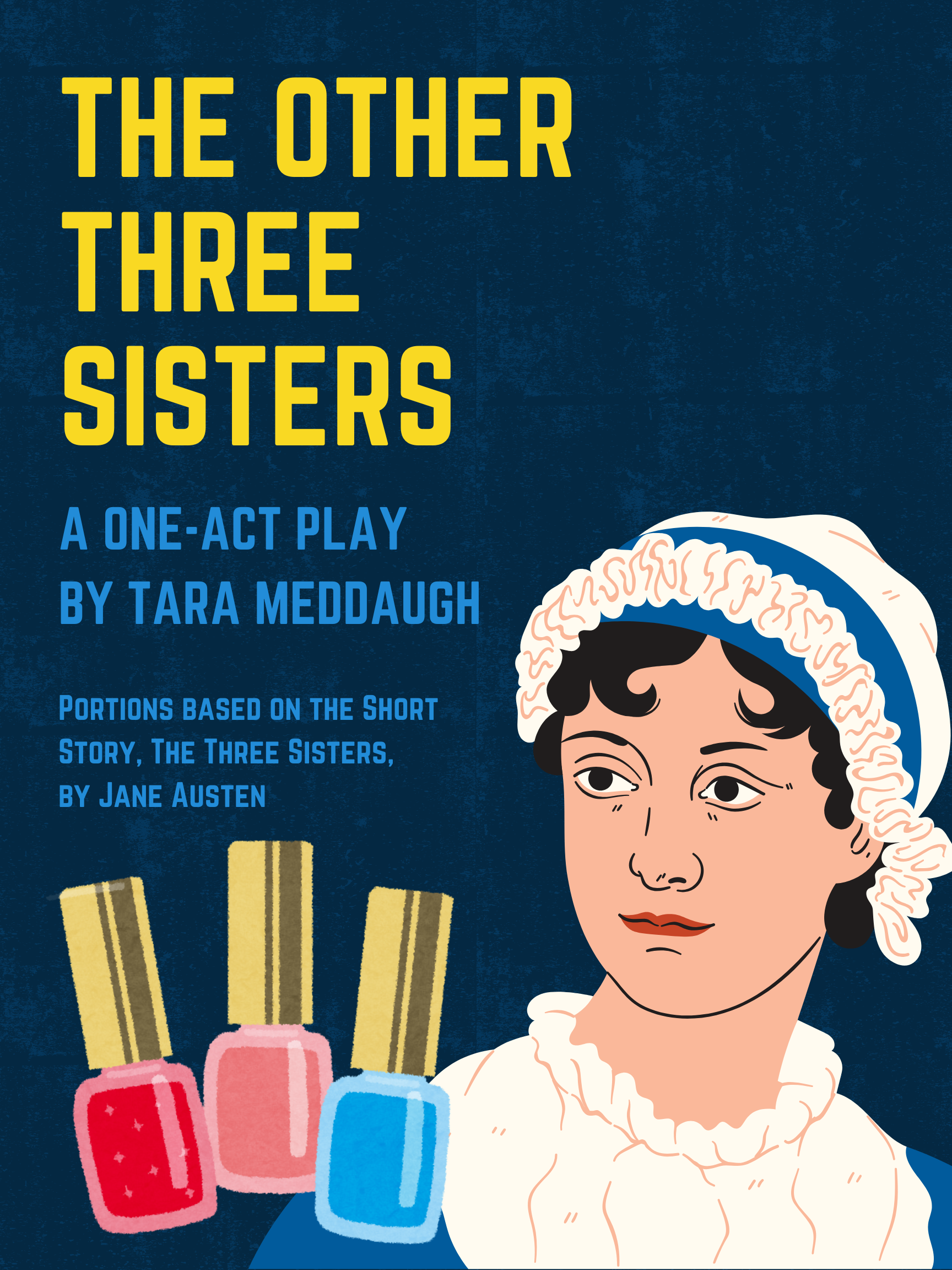
I looked for one of Austen’s more obscure pieces and found her hilarious short epistolary story, The Three Sisters (her story was before Chekhov—so yes, Austen had that title first). I adapted her story and juxtaposed the 18th Century sisters with a completely new story of 20th Century sisters, dealing with similar, but different, issues, 200 years later (same actors doubling their counterparts). I was fortunate to have professors who readily allowed and embraced this unique take on a thesis.
So—with advice from my theater advisor, playwright/novelist, David Pinner, and my English seminar advisor, Deborah Knuth, I wrote, then directed at Colgate the first production of THE OTHER THREE SISTERS (titled such, lest anyone think this was related to Chekhov!). I had the best possible actors I could dream of for every role (a couple were even in the Jane Austen seminar, as well). I remember after one performance, I was surprised to see my high school Social Studies teacher in the audience (from 2 hours away! Did my parents tell him about the show? Had I written to him? I don’t know!), and his main comment to me was, “I didn’t want this to end! Make it longer!”
Well, it’s not longer, friends. It runs about 40 minutes. But you can get your hands on this funny, a bit absurd, one-act play for 4 females and 1 male actor. This is a throwback to my earlier writing, so enjoy the voice of a 21-year-old Jane Austen/absurdist theater fan!
Maybe one day, I’ll take the Jane Austen sections, expand those and let them rest on their own… That’s another thing I had wanted to do while Debbie was still alive so I could share it with her… I guess we always think we have more time…
But for now—enjoy the play, on the 250th Birthday of a truly superb writer and strong woman, Jane Austen. In The Other Three Sisters, you’ll get to laugh at the absurdities of a young woman demanding ridiculous things of her potential fiance, whom she despises, but may marry to spite her neighbor. But you’ll also get to reflect a bit about the reality of their time, as well. As Professor Knuth said, this was the only real moment when women (and not even all women) had significant power in their lives: to say yes to a marriage proposal or to say no. Once married, a woman truly had little leverage or power until her husband died (Jane Austen had that opportunity to marry, at least once, and chose not to.). At the same time, you’ll also get to know the sisters of the 20th Century—and see how, while many things have changed, there are some issues we still face today. The play is about:
Intertwined scenes of a family are juxtaposed between the late 1700s of Jane Austen’s day, and the late 1900s in Queens, NY. 18th Century Mary must decide if she will wed on oaf she despises to make her neighbors jealous, as 20th Century Mary considers allowing back her missing husband who claims to have been sleeping for the years he was away. While the scenes span generations, the women encounter the same issues of marriage, money, and pride.
You can get the play below:

Intertwined scenes of a family are juxtaposed between the 1800s of Jane Austen’s day, and the late 1900s in Queens, NY. The 1800s Mary must decide if she will wed on oaf she despises to make her neighbors jealous, as the 1900s Mary considers allowing back her missing husband who claims to have been sleeping for the years he was away. While the scenes span generations, the women encounter the same issues of marriage, money, and pride.
-This is a one-act comedy for 5 actors (4 female/1 male).
And—
To Professor Knuth:
I am forever grateful to you for inspiring this love of Jane Austen and her literature, and also an appreciation of a century in our distant—and yet not so distant—past. I’m one of hundreds (thousands?) of students you taught and affected positively, not only through your teaching, but also through your kindness, your creativity, your openness, your example of a genuinely good human and mentor. I’ll miss your famous Christmas card updates and posts about Morwenna, your maine coone. And I’ll miss you, and the connection I had to you, however small it may or may not have been to you. Your family was lucky to have you and I’m sorry they lost you.
I’ll close with a quote from Jane Austen, which I find amusing and indicative of her witty humor—but which carries a sentiment I most definitely do not personally feel. In one of her letters to her sister, she writes:
“I do not want people to be very agreeable, as it saves me the trouble of liking them a great deal.”
― Jane Austen
Here’s where we disagree, Jane. I, for one, intend to stay open to the vulnerability of friendship and connection. Whatever troubles and pain and grieving liking someone may—or (sigh) inevitably, unfortunately, will—entail…it’s well worth the toll.